
September 8, 2026
Does Micro-Learning Actually Work for Revision?
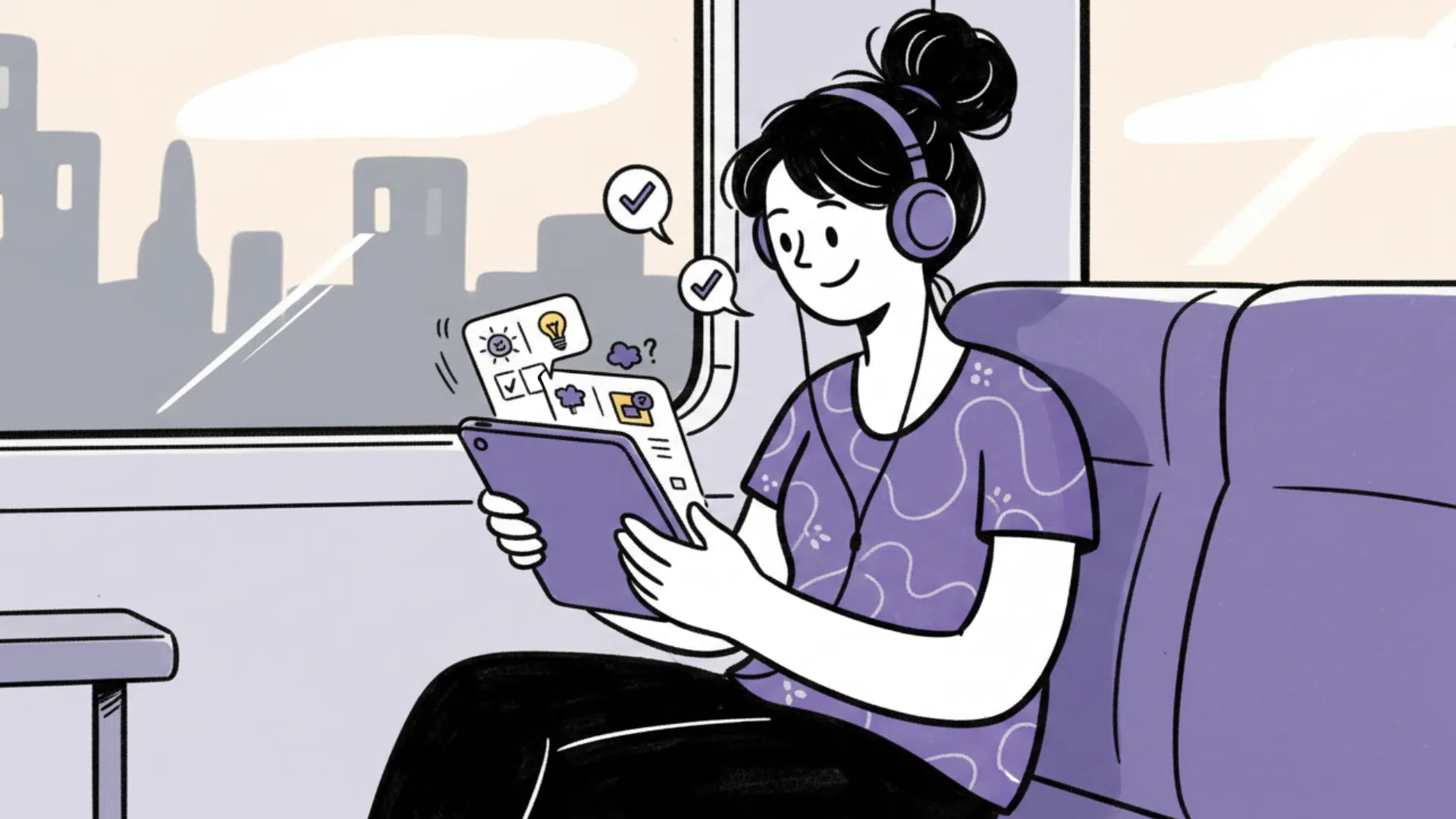
Short answer: sometimes. Longer answer: “micro-learning” isn’t really one thing, so “does it work” isn’t really one question.
Five-minute videos, daily flashcard streaks, a single quiz, push notifications with one fact in them. All of it gets filed under “micro-learning,” and there’s no single official or formal definition holding the category together – just a general sense that it’s shorter than a normal lesson.
That looseness is the actual problem with the question “does micro-learning work?” It sounds like one question, but it really isn’t. Watching a five-minute video passively and answering five quiz questions in five minutes both count as “micro-learning,” but cognitively they’re doing almost nothing alike – one is closer to a short lecture, the other asks your brain to recall information. Lump them together under one label and the research on “micro-learning” will look inconsistent, because you’re really looking for multiple answers simultaneously.
So before getting to whether it works, it’s worth being honest about what needs to actually be inside the format for it to work.
What the evidence actually supports
Strip away the “micro” branding and there are two specific techniques doing almost all of the real work: spacing study out over time instead of cramming it into one sitting, and testing yourself on material instead of re-reading it. Neither is new or trendy – they’ve been studied for decades – but they keep coming out on top whenever anyone rigorously compares study methods.
The most-cited review in this area looked at ten common learning techniques and rated only two as consistently high-utility across ages, subjects, and conditions: distributed practice and practice testing. This finding comes from a meta-analysis of 272 experiments, and it’s held up since – a larger follow-up analysis covering 242 studies and over 169,000 participants reached the same conclusion, naming distributed practice and practice testing as the most effective techniques of the ten reviewed. Meanwhile, the study habits most students actually reach for by default – re-reading, highlighting, summarising – consistently rank at the bottom. That’s not to say they don’t have uses, but it’s worth considering.
Micro-learning specifically has also started to be studied directly, rather than just inferred from the techniques it borrows. A 2024 systematic review of 40 studies on micro-learning in education and workplace settings found a consistent positive impact on learning outcomes across the research it examined – an encouraging early signal, even though the evidence base for “micro-learning” as its own category is younger and thinner than the decades of research behind spacing and retrieval individually.
None of this means five minutes beats an hour by default. It means that when a short session forces you to space things out and test yourself – rather than just handing you the same content in a smaller timeframe – you’re tapping into two of the best-supported techniques in the entire field of studying.
The “micro” part isn’t the magic ingredient. Spacing and retrieval are.
Why short sessions naturally encourage both
Practically, it functions a little like this. If a session only takes five or ten minutes, you can’t just do one session and call a topic finished – there’s not enough time in one sitting to cover it all. So, instead you end up coming back to the same material across several short sessions instead of one longer one. That’s spacing, whether or not you set out to do it deliberately or not. A three-hour cramming session in one go is the opposite: everything gets stuffed into a single block, then mostly forgotten, because you never thought about it again. Until the exam.
Short formats also lend themselves to testing rather than reading, almost by necessity. A five-minute video can only show you so much before it has to stop and do something else with the remaining time – the obvious “something else” is usually a question or two, because there isn’t room for a long, passive explanation. Compare that to a textbook chapter, which you can reread indefinitely and never really know what’s sticking.
None of this is guaranteed just by making something short – that’s the catch we’ll get to – but the format does lower the barrier. It’s much easier to accidentally end up spacing your revision when the unit of work is five minutes than when it’s an hour, and much easier to end up testing yourself when there isn’t room to just keep reading.
Where micro-learning doesn’t hold up
Two real limits are worth addressing plainly.
The first is depth. Complex or reflective topics – the kind that require you to hold several ideas in mind at once, weigh them against each other, or build a long argument – don’t compress well into five-minute chunks. Micro-learning can support that kind of thinking, but it can’t replace the sustained engagement it actually needs. You can learn ten vocabulary terms or a formula in a five-minute burst. Revising how several causes of a historical event fed into each other, or how three characters’ arcs connect across a novel, asks for far more than 300 seconds can deliver.
The second is that short doesn’t automatically mean effective. A lot of what gets marketed as micro-learning is just a shorter version of passive content – a bite-sized video with nothing to answer, nothing to retrieve, nothing spaced out over time. If it isn’t built around spacing or testing, it isn’t actually using the mechanisms that made micro-learning look promising in research in the first place – it’s just a shorter lecture, and a shorter lecture is still a lecture. Short content can still be badly designed. Being brief only works when it’s well-constructed.
It’s also worth knowing where most of the research comes from. A good chunk of the strongest evidence for micro-learning specifically sits in corporate training and university lecture replacement, rather than school or exam revision directly. The techniques underneath it transfer well – spacing and retrieval don’t change depending on subject – but it’s important to be a little more careful about the specific claim “micro-learning improves exam results” than about “spacing and testing improve exam results” Those concepts have a much longer, well-researched trail behind them, and are researched to this day.
How to tell if it’s actually helping, or if it’s just shorter
Since “micro-learning” doesn’t guarantee anything on its own, it’s worth having a quick way to check whether a specific tool, app, or habit is using the mechanisms that actually matter, rather than just cutting content into smaller pieces.
Start with spacing. Does the format bring topics back after a gap, or does it only show you something once and move on? A flashcard app that resurfaces a term a few days after you first saw it is spacing. A short video you watch once and never see again isn’t, no matter how bite-sized it was. The gap is doing the real work.
Then check retrieval. Are you being asked to produce an answer, or just shown one? Watching a five-minute explanation and reading a five-minute explanation are cognitively almost the same thing – the format changed, but you’re still just passively receiving information. A quiz, a question you have to answer before moving on, or a prompt to explain something out loud is different, because it asks your brain to pull the answer out rather than recognise it on the page.
A rough rule of thumb: if you could replace the short content with a long version of the same passive format and nothing about how you engage with it would change, the “micro” part isn’t doing much. If shortening it also introduced spacing or testing along the way, that’s the part actually worth keeping.
This applies just as much to your own habits as it does to any app. Five short revision sessions across a week that each end with a quick self-test are doing real work. Five short sessions that are just rereading a section of notes probably aren’t.
So… does it work?
The honest verdict: micro-learning works when it’s actually built on spacing and retrieval, and it doesn’t do much when it’s micro for the sake of it. The length was never the ingredient, but it does tend to go hand-in-hand with good technique.
If you’re picking a way to revise, duration matters less than the two questions from the last section: does it bring things back after a gap, and does it ask you to answer rather than just read or watch? Study Slam is built around both – spacing topics back into your queue over time and turning material into quizzes, rather than just chopping content into shorter pieces and calling it a day. Whatever you use, the same test applies: if it isn’t spacing you or testing you, being short isn’t buying you much.
Sources
Dunlosky, J., Rawson, K. A., Marsh, E. J., Nathan, M. J., & Willingham, D. T. (2013). Improving Students’ Learning With Effective Learning Techniques. Summary for educators: American Educator, AFT
Hattie, J., & Donoghue, G. (2021). A Meta-Analysis of Ten Learning Techniques. Frontiers in Education
Monib, W. K., Qazi, A., & Apong, R. A. (2024). Microlearning Beyond Boundaries: A Systematic Review and a Novel Framework for Improving Learning Outcomes. Heliyon