
September 16, 2026
Study Techniques for Autistic Students: Making Revision Manageable
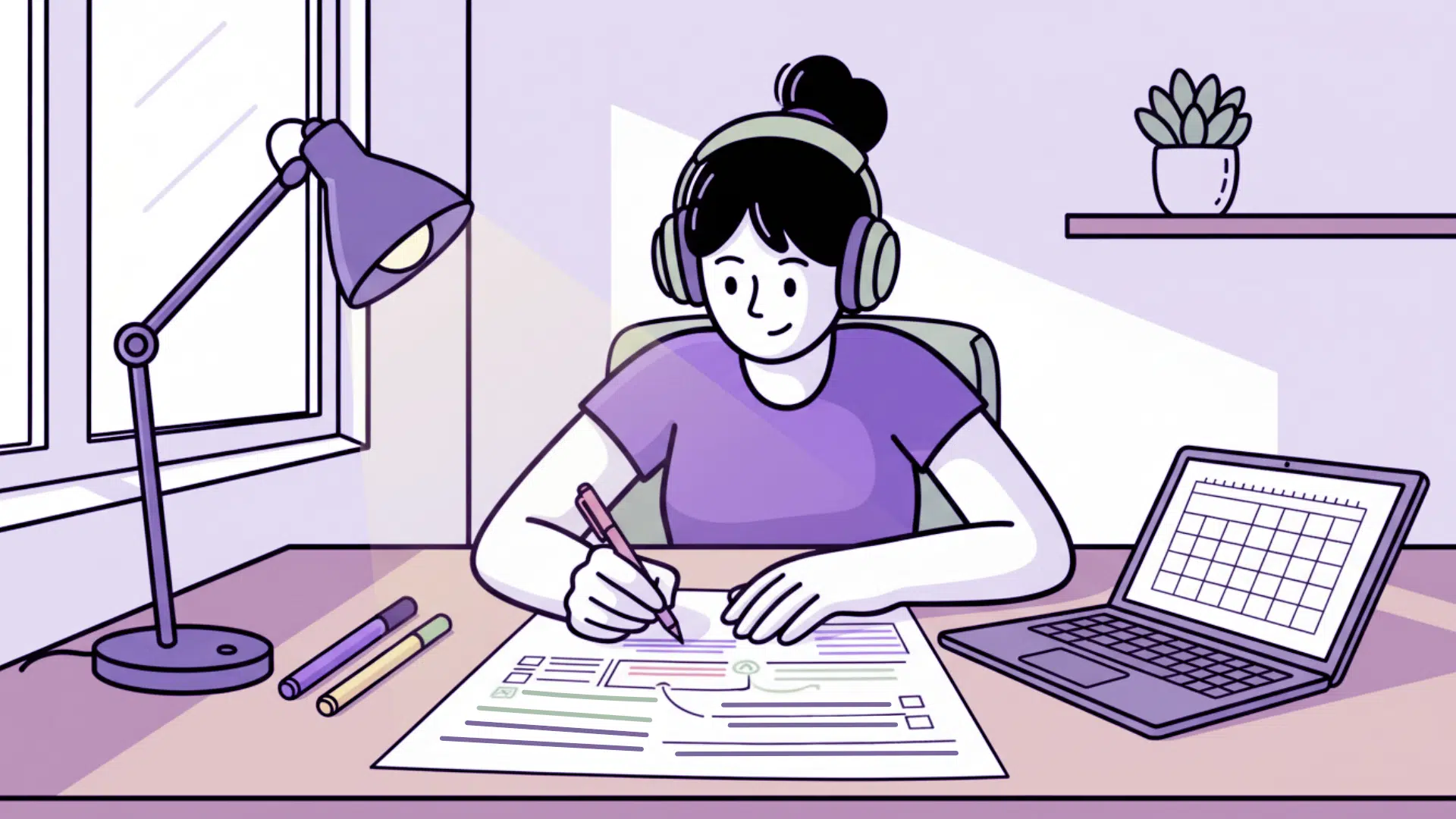
Revision comes with a lot of hidden questions.
You’re usually left to work out what to focus on, when to stop, and whether what you’re doing even counts as revising – all before you’ve done any actual studying.
For autistic students, that lack of clarity can make studying harder than it needs to be. The challenge is less about the subject itself. It can be the open-endedness around it: vague tasks and sensory distractions can make revision feel harder than it needs to be.
You’re probably trying hard already, so this is a sign that the study method actually needs more predictability and control.
A better approach is to make revision easier before you’ve even begun. For many autistic students, studying becomes more manageable when tasks are clearly defined, sensory distractions are reduced, and there is a visible structure to return to.
This guide explores practical study techniques for autistic students, with a focus on making revision feel calm and structured.
Why revision can feel harder for autistic students
Revision isn’t just the task in front of you. It is the environment, the instructions, the timing, the noise, the lighting, the materials, and shifting priorities.
Any one of those things can add friction, especially for autistic students. A revision session might be difficult because the room is too loud. Or the textbook pages are too busy. Or the task is too open-ended. Even when the subject itself makes sense, everything around it can make studying hard to begin and harder to stay with.
Unclear expectations can be especially draining. If you are told to “revise the topic”, but not what level of detail is expected, you can be left trying to interpret the classroom resource when you’re meant to be revising it.
Transitions can be difficult too. Starting revision means shifting out of whatever you were doing before. Stopping means trusting that you have done enough for now. Moving from one subject, format, or environment to another can take more energy than other people realise.
Motivation rarely survives an unclear revision task. Making the task itself easier to revise matters more.
Turn vague revision into clear tasks
An open-ended revision task leaves too much to interpret.
“Revise psychology” might sound like a task, but it does not tell you where to start, what to do first, how much detail to cover, or when you are supposed to stop. That uncertainty can make the task feel bigger than it really is.
A closed task is different. It gives revision a clear shape.
Instead of setting yourself an objective like “go over my notes”, try making the next step specific:
- Answer five questions on one topic
- Summarise one theory in five bullet points
- Watch one short explanation, then write down three things you understood
- Review the parts of one chapter you found confusing
- Spend ten minutes checking yesterday’s mistakes
- Make a list of three things to ask your tutor or teacher
What matters isn’t the length of the session so much as whether it has a clear start, middle, and end.
For autistic students, detailed revision planning can reduce some of the uncertainty around revising. You know what you are doing and what the expected progress is. That makes revision easier to begin or return to later – you know what needs to be done.
It can also make breaks feel more comfortable. If the session has no clear end, stopping can feel like you are doing something wrong. But if you know you have completed the task you set, taking a break becomes part of the plan rather than a guilty feeling.
A good revision plan should not leave you guessing -you should know what comes next.
Reduce the sensory load around revision
Sometimes making revision easier is about managing what’s around you.
A busy room, harsh lighting, background noise, a cluttered desk, uncomfortable clothes, constant notifications, or a screen that feels too bright. All of it can chip away at your concentration. You might still understand the revision content, but the environment is taking up energy before you have even properly started.
Few people have a perfect study space, and you don’t need one either. But small changes can make revision feel less demanding.
You might find a quieter room, turn off telephone notifications, use headphones, clear only the space directly in front of you, or use a font and background colour that feel easier to read. If a library feels too busy, you don’t have to force yourself to study there just because it looks like the “right” place to revise.
It can also help to reduce clutter in the revision material itself. A page packed with text, colours, diagrams, side notes and tabs can quickly become overwhelming. Shorter chunks, clear headings, simple layouts and fewer competing visuals make it easier to know where to look first.
You won’t remove every distraction, and you don’t need to. Cutting the avoidable ones frees up energy for the learning itself, rather than for coping with everything around it.
Plan transitions before you start revising
Starting revision can be difficult…but so can stopping. So can moving from one subject, format, or revision task to another.
That’s where planned transitions come in.
If your revision schedule assumes you can instantly jump from lunch to studying, from maths to English, or from reading to answering questions, it may be asking too much too quickly. The shift in itself can use up energy before you’ve put a pen to paper.
It can help to build small transitions into the session. Before you start revising, give yourself a few minutes to get set up, open the right material, check the revision task, and remind yourself what “done” looks like. At the end, write down what you completed and what the next step will be, so you are not returning to a blank space later.
Breaks work better when they have shape too. An open-ended break raises the same problem as an open-ended revision task – no clear length, no clear activity, no clear way to know if it was effective.
Try making the break guidelines as clear as the revision task:
- Five minutes away from the screen
- One drink or snack
- One short walk
- Ten minutes with headphones on
- A clear return point, such as “come back and answer three more questions”
The right type of break should make it easier to return to revision, not harder. For some students, that might mean quiet. For others, it might mean movement, music, or stepping away from a busy room. What matters most is that the break helps you reset without making the next transition feel impossible.
Revision does not need to be one long push from start to finish. In fact, it should have breaks and pauses. When they are planned well, they can make the whole process feel easier.
Use preferred formats where possible
Revising can take all sorts of formats – some will feel more suitable than others.
For some autistic students, that might be visual notes, diagrams, audio, quizzes, videos, or very detailed source material. It might mean starting with the part of the topic that feels most interesting, because that gives you a way in – that’s often the most sensible way to begin.
The risk is getting stuck there.
You might spend too long perfecting a diagram, researching one detail, rewriting the same section, or staying with the topic you enjoy while avoiding the one that feels vague or boring. But more often than not, those are the ones that need more attention.
A useful approach is to use your preferred revision format as the entry point, then decide the next step before you begin. For example:
- Watch one video, then answer five questions
- Make one diagram, then explain it out loud
- Read one section, then write down three points you remember
- Start with the topic you like, then spend ten minutes on the one you usually avoid
- Use detailed notes for understanding, then switch to a short quiz for recall
This keeps your revision focused on what you need to do.
Interests can help too. If a subject connects to something you already care about, use that link. It can make the topic easier to enter and easier to remember. But revision still needs a direction. So how do you maintain interest without getting stuck in it? Treat it as a bridge – a way back into the material you actually need to learn, not a destination in itself.
So… what now?
If you want a revision tool built around this kind of structure, Study Slam turns notes, PDFs, videos or any topic from scratch into key notes, quizzes and audio lessons, with scheduling, reminders, in-built accessibility settings and source access – so the plan is visible rather than something you have to hold in your head.
But the revision structure matters more than any particular tool. Set clear tasks with a defined end. Reduce the sensory load where you can. Build transitions and breaks in before you need them, not after you’ve already run out of energy. Use the revision formats that work for you, and treat your interests as a way in rather than a place to get stuck.
Give revision a structure, and guesswork stops being part of the process,