
September 15, 2026
Revision Techniques for Dyslexic Students: How to Study Without Just Rereading
A lot of revision advice assumes reading your notes again and again is the obvious starting point. For dyslexic students, that can make revision harder than it needs to be.
If dense pages take longer to process, if key points blur together, or if copying notes creates even more text to work through later, rereading can become frustrating instead of helpful. You might understand the topic perfectly well in a lesson, but still find it difficult to pull out the key information back from a page of multicoloured notes.
This has nothing to do with effort. It’s what happens when a revision method leans entirely on reading, spelling, and written recall.
A better approach is to make information easier to access in the first place. For many dyslexic students, revision becomes more manageable when it is more visual, more active, in an audio format, or broken into smaller chunks of information that are simpler to return to.
This guide explores practical revision techniques for dyslexic students, with a focus on studying in ways that help you see, hear, test, and remember information without relying on rereading alone.
Why traditional revision can be harder for students with dyslexia
Revision is more than just understanding a subject – it’s about accessing the information, on demand, when you need it.
That is where traditional revision techniques can become difficult for dyslexic students. A page of notes might contain everything you need, but if it is dense, cluttered, in fonts you dislike, or hard to scan, finding the key information can take more effort than when you learned it in the first place.
Rereading can also be tiring. When you have to spend extra energy decoding words or working out where one idea ends and another begins, there is less energy left for understanding and remembering the content itself. You’re using more brain power just to get started.
This can make revision feel slower than it should. You might read the same paragraph several times and still not feel confident. You might know the answer when someone asks you out loud, but struggle to write it down clearly. You might spend ages making notes, only to come back later and find they are impossible to use because your own handwriting is too difficult to read.
Telling yourself to read more carefully or write neater notes doesn’t solve this. The pressure has to come off reading and writing as the only route in.
Good revision techniques should help you see the structure, see the key points, test what you remember, and return to the material without starting from scratch every time. Often, spending hours writing notes using a pen and paper is not the best way to do this.
Make revision visual before it becomes written
If a page of notes feels hard to use, the answer is not always to make more notes. There’s only so much you can do by chopping and reworking text.
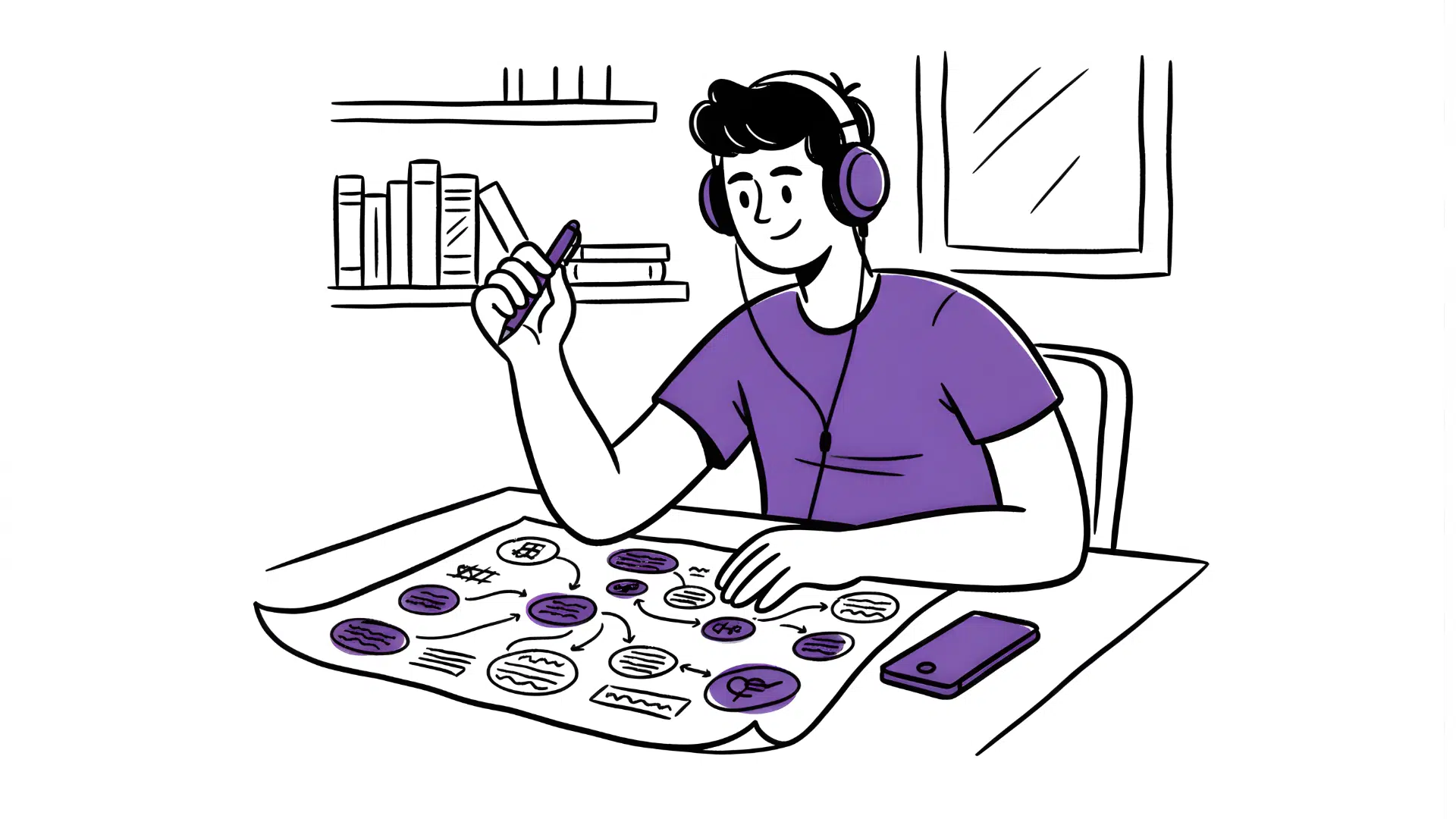
For some dyslexic students, it can be more helpful to turn information into a visual format first. That might mean a mind map, diagram, timeline, flowchart, table, or even a very simple topic web with the main idea in the middle and the supporting points around it.
A visual layout makes the structure easier to see at a glance.
A long paragraph can hide the relationship between ideas. A mind map can show you what belongs together, what causes what, what happened first, and which points support the same argument. Instead of trying to remember a wall of linear text, you are giving your brain something easier to scan and recall later on.
This can be especially useful when planning essays or revising topics with lots of connected parts. For example, instead of writing out everything you know about a historical event, you could split it into causes, key people, consequences, and dates. Instead of copying a science chapter into another set of notes, you could turn the process into a labelled diagram or sequence of steps.
Colour can help too, but only when it has a job. If everything is highlighted, nothing is. Try using one colour for key terms, another for examples, and another for things you need to revisit. Keep it simple enough that the future-you can understand it quickly.
Once the structure is visible, revising often becomes easier. You are no longer starting with a blank page or a stack of notes. You have a map of the topic, and you can use that map to explain the idea and test yourself, before deciding what needs a second look.
Reading and writing still play a part – they just share the job with other formats.
Use audio as another way into the material
Reading is not the only way to revise.
For dyslexic students it’s important to remind yourself of this. If most of your revision depends on reading dense notes, textbooks, slides, and handouts, fatigue can build quickly. By the time you have decoded the material and worked out what matters, you may have already used up a lot of the energy you needed for remembering it. Almost like running 5km then starting a half marathon.
Audio gives you another route in.
That might mean listening to a summary of your notes, using text-to-speech, recording yourself explaining a topic, or playing back key revision points while you walk, commute, cook, or take a break from your screen. Hearing information aloud can make it easier to follow the flow of an idea, especially when the written version feels crowded or difficult to scan. Plus, it gives flexibility. You can listen to a 2-minute summary while you brush your teeth, or a 15-minute deep dive while you do your laundry.
Listening can also help you take in information. Reading the same page again and again can become frustrating, but listening to a short explanation more than once may feel less draining. You can pause, replay, slow things down, or pair the audio with the written notes so you are seeing and hearing the information at the same time.
That combination can be powerful. You are not asking your brain to do everything through text alone. You are giving it more than one signal: the sound of the explanation, the shape of the topic, the key words on the page, and your own memory of what came before.
Audio revision will not suit every moment, and it does not mean you never need to read. But when reading starts to feel like the barrier, listening can help you stay connected to the subject instead of giving up on the session completely.
Turn notes into questions, not more notes
When revision feels unclear, it is tempting to make another set of notes. To copy out the previous session’s work word for word and hope it drills itself into your mind.
Sometimes that helps. But if you are dyslexic, it can also mean creating more text to process later. That page then becomes a summary. The summary becomes flashcards. The flashcards become a new pile of things to read. Before long, revision has turned into a long funnel of admin, and scrawls to decipher.
Questions can cut through that.
Instead of asking, “Have I read this topic enough times?”, ask, “Can I answer something about it?” That small shift changes revision from recognition to recall. You are no longer checking whether the page looks familiar. You are checking whether the information is there when you need it – and that’s what counts.
For example, instead of copying out a paragraph about photosynthesis, you could turn it into three questions:
- What does a plant need for photosynthesis?
- What is produced during photosynthesis?
- Why is chlorophyll important?
You can answer in writing, say the answer out loud, draw it as a mind map, or talk it through with someone else. The answer does not need to be perfectly written for the revision to count. What matters is whether you can retrieve the idea and explain it in a way that makes sense.
This is especially useful when written recall feels stressful. If spelling, sentence structure, or handwriting takes up a lot of your attention, oral recall can help you check understanding without making writing the first barrier. You can always turn the answer into a written version later on.
Quizzes, practice questions, verbal explanations and “cover and recall” exercises all help you find out what has actually stuck. They also show you what hasn’t, which is much more useful than simply rereading everything again and hoping the important parts stay in place. You’ll know where to direct future revision.
Make your notes easier to revisit
Often, your notes make the most sense when you’re in the moment. But they need to be easy to return to, too.
That is why removing visual clutter matters. A page might feel useful while you are making it, especially if you are highlighting, underlining, colour-coding and adding notes in the margins. But when you come back a week later, it can be hard to know where to look first. A rainbow-coloured stack of notes can be just as baffling as a black and white one. For dyslexic students, this can make revision more tiring than it needs to be.
Try making your notes easier to revisit. That could mean:
- using clear headings
- leaving more space between points
- keeping paragraphs short
- using bullet points where they help
- choosing fonts and text sizes that feel comfortable
- using background colours or overlays that reduce visual stress
- highlighting only the words or phrases that genuinely matter
The goal is simple: the future-you should be able to understand what the present-you was trying to make stick.
A good test is this: if you opened the same page you looked at today tomorrow, would you know where to start? Would the key points stand out? Would you be able to tell what needs revising again? Keep asking yourself those questions. The easier your notes are to return to, the less energy you spend decoding the page before revision has even begun.
So… what now?
Dyslexia-friendly revision comes down to accessing information in more than one way – visually, aloud, through questions, and through notes you can actually revisit later.
Make the structure visible. Use audio when reading gets tiring. Turn notes into questions. Reduce clutter. Give yourself more than one way back into the material.
The way you revise still matters, even once the format changes. If you want a tool built around this kind of studying, Study Slam turns notes, PDFs, videos or a topic from scratch into key notes, quizzes and audio lessons, with built-in accessibility settings so you are not relying on rereading alone.