
September 9, 2026
How to Revise When You Can’t Concentrate
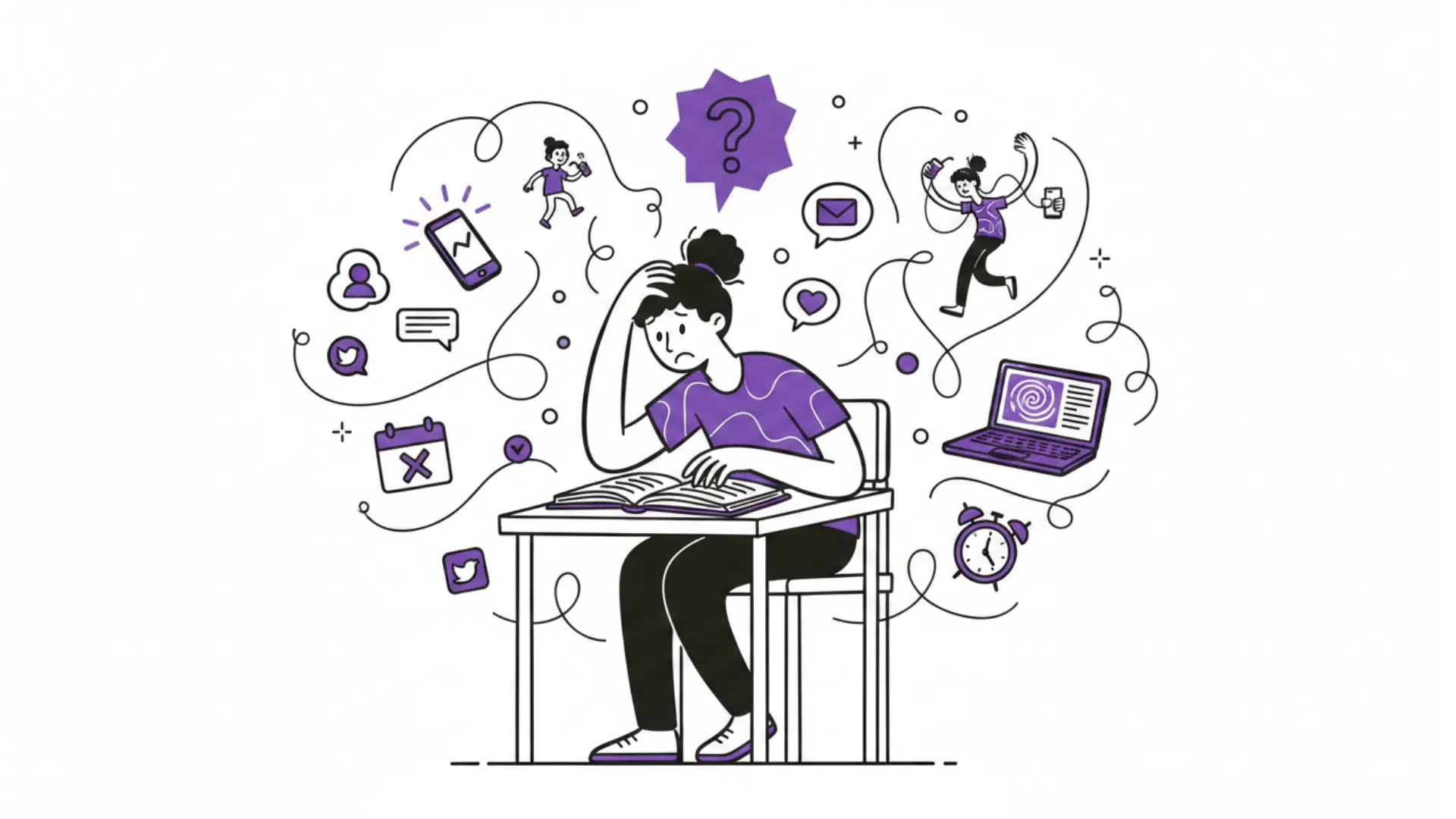
You’ve opened the notes. You’ve got the laptop out. Maybe you’ve even made a cuppa. Ten minutes later, you’ve read the same line six times and somehow know less than when you started.
This isn’t really about laziness…and it isn’t really about the subject either. It’s usually one specific thing getting in the way – and once you know which one, the fix is often easier than you imagined.
When concentration begins to fade, it’s often about changing the task, the format, the environment, or the size of the session. It all depends on what’s actually wrong.
This guide walks through the different reasons concentration lapses, and what to try when it does.
First, work out what kind of “can’t concentrate” this is
“I can’t concentrate” gets used for a lot of very different problems. Tired-can’t-concentrate is not the same as bored-can’t-concentrate. Overwhelmed-can’t-concentrate needs a different fix than distracted-can’t-concentrate. Treat them the same way and you’ll end up trying to fix the wrong thing.
A few common versions:
- Too tired – your brain isn’t refusing: there’s just nothing left to give.
- Too overwhelmed – there’s so much to cover that every starting point feels wrong.
- Too bored – the task is dull enough that your attention goes looking for something else. Probably your phone.
- Too distracted – a song, a different tab, a dog barking outside, or a thought keeps pulling you away.
- Too unclear – you don’t actually know what you’re meant to be doing, so there’s nothing to focus on.
- Wrong format – you’re reading when you need to be doing, or sitting still when you need to move.
Worth a minute before you start: which one of the above is actually going on right now? The rest of this guide is organised around fixing each one differently, because “just focus” is never going to work when the real problem was something else.
If the task is too big, shrink it to a first step
Big, vague goals are where concentration goes to die. There’s no obvious place to start, no clear middle, and no way to tell if you’re doing it right – so your brain looks for something else to do instead. Looks like the kitchen might need tidying.
The fix is relatively simple: make the task small enough it doesn’t require mountains of motivation.
Don’t promise yourself an hour, and certainly don’t promise yourself the whole topic. Focus on the first five minutes, with a task specific enough that you can’t talk yourself out of it – answer three questions. Read one page. Write down all that you remember on a topic.
None of these look impressive on a revision timetable. That’s fine, we don’t need them to. A vague hour-long block gives your brain too many chances to bail before it’s really started: a five-minute task with a clear end doesn’t give it that option, because there’s nowhere to bail to. You either haven’t started, or you’re already most of the way through the task.
The useful trick here is that concentration is much easier to find once you’re already engaged in study than it is to summon before you’ve started. Once you’re five minutes in, carrying on is usually the easy part – you’re no longer trying to talk yourself into beginning, you’re just continuing something that’s already underway. Your brain hits its groove. The hard part was starting: shrinking the task is really just a way of tricking yourself into doing just that.
If rereading isn’t working, switch to recall
Rereading often feels a bit too much like revision. You’re sitting there, the book’s open, time is passing. But it’s a strange feeling: your eyes are moving across the page but your brain checked out a while ago. You get to the bottom of a paragraph and realise you have no idea what it said. So you start back at the first line.
Your lack of concentration is probably linked to the task at hand. Reading doesn’t ask anything of you, so there’s nothing to hold your attention. Recall fixes that.
Instead of reading a page again, try answering something instead:
- Cover the page and write down what you remember
- Turn the heading into a question, then answer it without looking
- Explain the idea out loud, as if to someone who’s never heard of it
- Do a quick five-question quiz on what you just read
The difference isn’t really about which method is “better” in the abstract. It’s that recall gives your brain a job, and a wandering mind is much easier to rein in when it’s got a specific task. Rereading gives your brain nothing to fail at, so it doesn’t notice when it’s checked out. Recall gives it a clear task, so the moment your attention drifts, it’s obvious – you can’t answer the question, or the words won’t come when you try to explain it out loud.
That’s useful information, not a setback. If you draw a blank, you’ve just found the part that needs another look. With rereading you probably wouldn’t be able to tell either way – that’s the whole problem with it.
You don’t need to get everything right first time – you’re not being marked. You’re finding out what’s actually stuck, so you can stop wasting time revisiting information you already know.
If your brain keeps wandering, change the format
You shrink the reading down to one page and still find your concentration waning. A list of questions just looks like a blur. At that point, the issue stops being the scope of work: it’s that text, specifically, has stopped working for you right now.
Concentration isn’t something you either have or you don’t. It shifts depending on what you’re asking your brain to do and how. A format that works fine in the morning can feel impossible by 4pm. A format that’s fine for one subject can feel unbearable for another. When that happens, switching the format is often faster than trying to force the original revision strategy to work.
If reading isn’t landing, try listening instead – record yourself explaining the topic, or find an audio summary and let it run while you do something else. If sitting still is the problem, get up. Walking while you listen, or pacing while you talk through an answer out loud, gives your body something to do so your brain isn’t the only thing working. If silent revision is going nowhere, say it out loud, even to an empty room – hearing yourself explain something catches gaps that reading through them might not. Even if talking to nobody feels strange.
Dense notes that have turned into a wall of text can become a quick mind map instead, and a session that’s gone completely flat can often be woken back up with a short quiz, since a task with an actual outcome asks more of your attention than passively looking at a page ever will.
None of these are the “correct” way to revise. They’re just different entry points into the same material, and one of them is usually less blocked than the others at any given moment. If you’ve tried the obvious format and your attention still wanders, don’t just push harder – try to find a different route into the content. You might just find it gets you focused for an extra hour or two.
If you’re distracted, let fewer things compete for attention
Your phone buzzes, then a tab you forgot was open blasts an ad, then someone in the house starts doing the washing up (but it sounds like they’re throwing pans around). None of these are new problems, but revision seems to make you notice all of them at once, mostly because concentrating on something text-heavy makes everything else suddenly look fascinating by comparison.
The usual advice here is “remove all distractions,” which is true in theory and useless in practice, because you don’t live in a soundproof pod. Nobody is going to have the perfect environment, but you can lower the number of things grabbing your attention.
Start with whatever’s easiest to actually close. Put your phone in another room, not just face-down – face-down still buzzes, and you’ll still think about it. Close tabs down to the one you need, not the eleven you’re “going to get to.” Turn notifications off, not muted, since muted still shows up as a little red dot waiting to be checked. None of this removes distraction entirely, but when you’re trying to lock in on the Treaty of Versailles it’s a few less things to think about.
The messier kind of distraction is the one in your head – the thing you suddenly remember you need to do, the argument you’re replaying, the thought that arrives uninvited and won’t leave. Trying to force it out rarely works. Writing it down usually does. Keep a sheet of paper next to you and dump anything that shows up mid-session onto it, with a promise to deal with it later. It’s not gone, but it’s parked somewhere that isn’t the inside of your working memory. Sometimes, that’s good enough to get going again.
Know when to stop forcing it
Sometimes none of the above works. That’s your body telling you something this article can’t fix.
If you’re exhausted, no format change will help – you need sleep. If you haven’t eaten in six hours, that’s hunger showing up as an inability to focus. If you’ve been revising for two hours straight, a five-minute walk will probably do more than another twenty minutes of quizzing yourself.
Don’t give up at the first sign of difficulty: instead, notice when the problem isn’t revision-shaped anymore. Forcing a session that your body has already opted out of usually just means an hour of frustration and nothing learned – you’d have done just as well stopping earlier and coming back with some renewed energy.
Sometimes the most productive thing you can do is close the laptop and come back later. Don’t beat yourself up over it.
So… what now?
Concentration rarely evaporates in an instant, and rarely for one reason. Sometimes you’re too tired, sometimes the task’s too vague, sometimes you’re reading when you should be talking out loud. The fix is usually to work out what type of concentration challenge this is and pivot to a different method of revising.
If you want a tool that helps you switch formats without starting from scratch each time, Study Slam turns your notes, PDFs, videos or any topic into key notes, quizzes and audio lessons – so when reading stops working, listening or testing yourself is already one tap away. Whatever way you decide to revise, the point stands either way: don’t fight your brain when it’s telling you something’s not working. Change it, don’t blame it on willpower.